

This guide to Philippines scuba diving will help you plan your trip! I highly recommend diving in the Philippines. It’s one of the top diving countries in Asia, alongside Indonesia, Malaysia, and Thailand.
I visited Tubbataha Reef and Anilao, so there will be extra information on those areas, but this post also covers other diving areas in the Philippines. Use this guide as a trip planning primer and then dive deeper. There is a lot of information in this post, so scan through and then zero in on each section to go deeper.


How to Plan Your Philippines Dive Trip
Here are some pointers to guide your planning:
- What do you want to see while diving?
- How many days is your trip? Do you have enough time to visit multiple places?
- What is your budget?
- Dive shop or dive resort or liveaboard?
- Do you want to stay at one resort for an extended period or island hop to different dive areas?
- What else do you want to see/do on your trip? Do you want to be somewhere with topside activities?


Here are some of my notes in hindsight:
- Dive areas in the Philippines are focused on diving, meaning there aren’t places with both diving and abundant land activities. You’ll likely visit small islands.
- Our Tubbataha Reef liveaboard was great, but because the dive profiles throughout the trip were very similar, I’d consider a liveaboard that also visited Apo Reef and Coron for more variety.


Where to Dive in the Philippines
With over 300 dive sites, the Philippines has a variety of different things to see when scuba diving, though you’ll have to travel to different areas to get guaranteed sightings. Most visited areas include: Tubbataha Reef and Coron Bay from Palawan, Malapascua and Moalboal from Cebu, and Anilao and Puerto Galera from Batangas.
You’ll likely be flying internationally into Manila (MNL) or Cebu (CEB) and then taking a domestic flight to the specific area. Our round-trip flight from Manila to Puerto Princesa, Palawan (port for Tubbataha Reef) was about $100 per person.
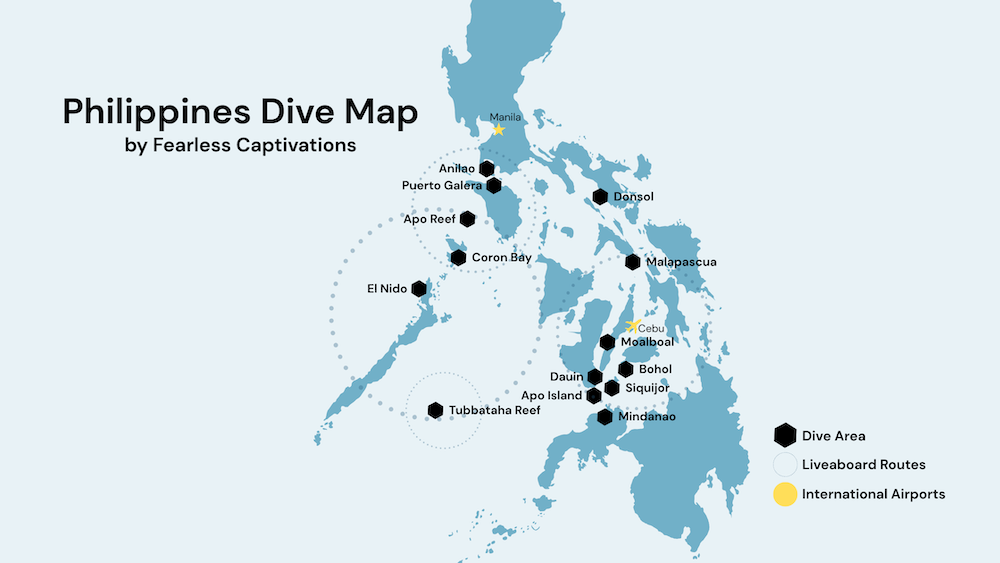
Here’s a quick list of where to go, the closest airport, and what type of diving it’s known for:
- Anilao – Nudibranch capital of the world, muck diving
- Fly into Manila, drive around 3 hours south to Batangas
- Apo Reef – coral reef
- Fly into San Jose Airport (SJI), 2-3 hour boat
- Bohol – reefs, wall dives, turtles
- Fly into Bohol–Panglao International Airport (TAG)
- Coron Bay – wreck diving capital of Southeast Asia
- Fly into Francisco B. Reyes Airport (USU), drive 30-40 minutes
- Donsol – whale shark snorkeling
- Fly into Bicol International Airport (DRP), drive 2 hours
- Dauin/Siquijor/Apo Island – muck diving, reef
- Fly into Dumaguete-Sibulan Airport (DGT), take car or boat/ferry
- Malapascua – famous for thresher sharks
- Fly into Cebu, drive 3.5-3.5 hours, take 30-45 minute boat
- Mindanao – reefs, walls, macro
- Fly into Mactan-Cebu International Airport (CEB) or Davao (DVO)
- Moalboal – sardine run, wall dives
- Fly into Cebu, drive 2-4 hours
- Puerto Galera – a little bit of everything; macro, wreck, pelagic
- Fly into Manila, drive around 3 hours south to Batangas, take a ferry for 1 hour or private boat for 30 minutes
- Tubbataha Reef – liveaboard only, very healthy reefs, wall dives, micro and macro
- Fly into Puerto Princesa, Palawan; the liveaboard port is a few minutes away
We chose the dive areas for our trip because Tubbataha Reef is known as one of the best places to dive in the world, and as a fan of nudibranchs, I wanted to visit an area with guaranteed sightings.


Best Time to Dive in the Philippines
The best time to dive depends on where you want to go and what you want to see. Consider dry vs wet season, high tourist season, water/wind conditions (choppier seas), and typhoon possibilities.


Below shares the typical time period that experts recommend to dive the area. This is typically the dry season, though keep in mind that you could visit some places at other times, but what you’ll see and the water conditions will be different.
- Anilao – November to May
- Apo Reef – December to May
- Bohol – February to June
- Coron Bay – December to May
- Dauin – December to May
- Donsol (snorkeling) – November to June
- Malapascua – March to June
- Mindanao – March to September
- Moalboal – December to April
- Puerto Galera – November to May
- Tubbataha Reef – March to June


Liveaboard Options in the Philippines
There are about 13-15 liveboard options in the Philippines. They are 4 to 12 nights, with the majority at 6 or 7 nights. The most affordable is about $278 per day and goes up to $458 per day, totaling $1,700 to $6,475 per person. I like using Liveaboard.com to research boats since it aggregates all options uniformly.
Typical routes include:
- Apo Reef, Coron, Anilao
- Tubbataha Reef
- Visayas North: includes Malapascua, Bohol, Maolboal
- Visayas South: includes Siquijor and Apo Island
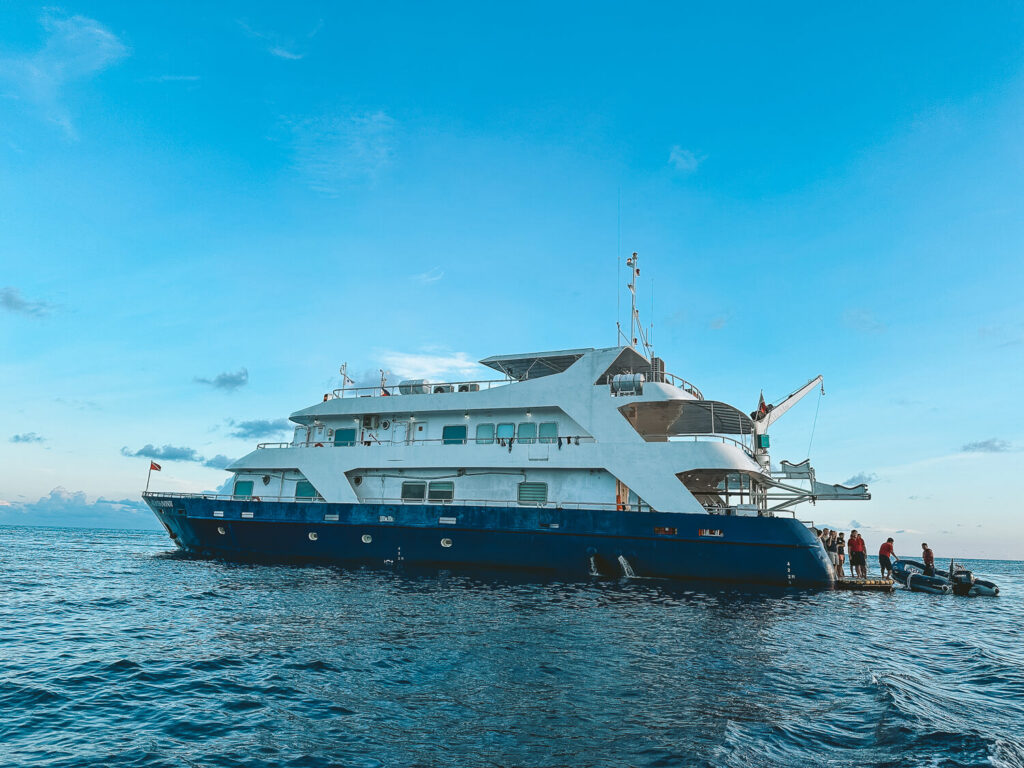
Our liveaboard, Atlantis Infiniti, was focused on Tubbataha Reef, where there are three atolls. We had a great time on our boat – good food, outstanding service, comfortable rooms, and quality equipment. If you want to see more than just Tubbataha Reef, liveaboards with more than 7 nights also visit Apo Reef and Coron.


Our liveaboard was on the more expensive end of liveaboard options. The liveaboard was $3,800 per person, not including park fees, fuel surcharge, gear rental, and tips, which amounted to an additional $700 per person. (It is recommended to pay 10-15% of the liveaboard cost for tips.)
Diving Tubbataha Reef
Tubbataha Reef is known for its biodiversity; it’s home to over 600 fish species and 350 coral types. Because of its isolation and protection as a UNESCO World Heritage Marine Sanctuary, the park is only accessible by liveaboard from March to June. Some liveaboards only dive in Tubbataha, while a few longer liveaboards also visit nearby Apo Reef and Coron.
Quick Stats
- Port: Puerto Princesa, Palawan
- Water Temperature: Ranges from 27-30°C / 81-86°F, with visibility often exceeding 30 meters / 100 feet
- Dive profile: many wall dives ending on top of a reef, occasional currents
In Tubbataha Reef, we typically saw groups of sharks and an abundant variety of fish and coral on every dive. They were typically wall dives ending on top of the reef for the last 15-20 minutes. We flowed with the current, so dives were typically not strenuous. Some things I enjoyed seeing were nudibranchs, sea stars, clown fish, clams, octopus, unicorn fish, and porcelain crabs.


Diving Anilao
Anilao is known as one of the world’s best places for macro diving. It’s also widely described as the “nudibranch capital of the world,” so as a nudibranch lover, it was a must!
We stayed at Buceo Anilao Beach & Dive Resort, a secluded dive resort in the area, and dive sites were no more than 20 minutes away. It truly was a nudibranch paradise. We saw at least 10 different types on every dive. It wasn’t only nudibranchs in the muck. We also saw frog fish, banded sea krait, electric clam, and mantis shrimp.


Dive Shops and Dive Resorts in the Philippines
Here are a few recommended dive shops and resorts around the Philippines. Use the PADI website to find more options.
For dive shops or dive resorts that aren’t secluded, dives cost around $35-40 USD per dive.
- Dauin – Atlantis, Atmosphere
- Malapascua – Evolution, Sea Explorers
- Moalboal – Cebu Seaview Dive Resort
- Puerto Galera – Arkipelago, Atlantis
- Siquijor – Bahura Dive Center


I’ll look back at this Philippines trip with so much joy! It was an ideal liveaboard experience and a life-changing experience trying muck diving. I hope you get to experience diving in the Philippines for yourself!
Need more scuba diving inspiration? Check out these posts:
You might also like